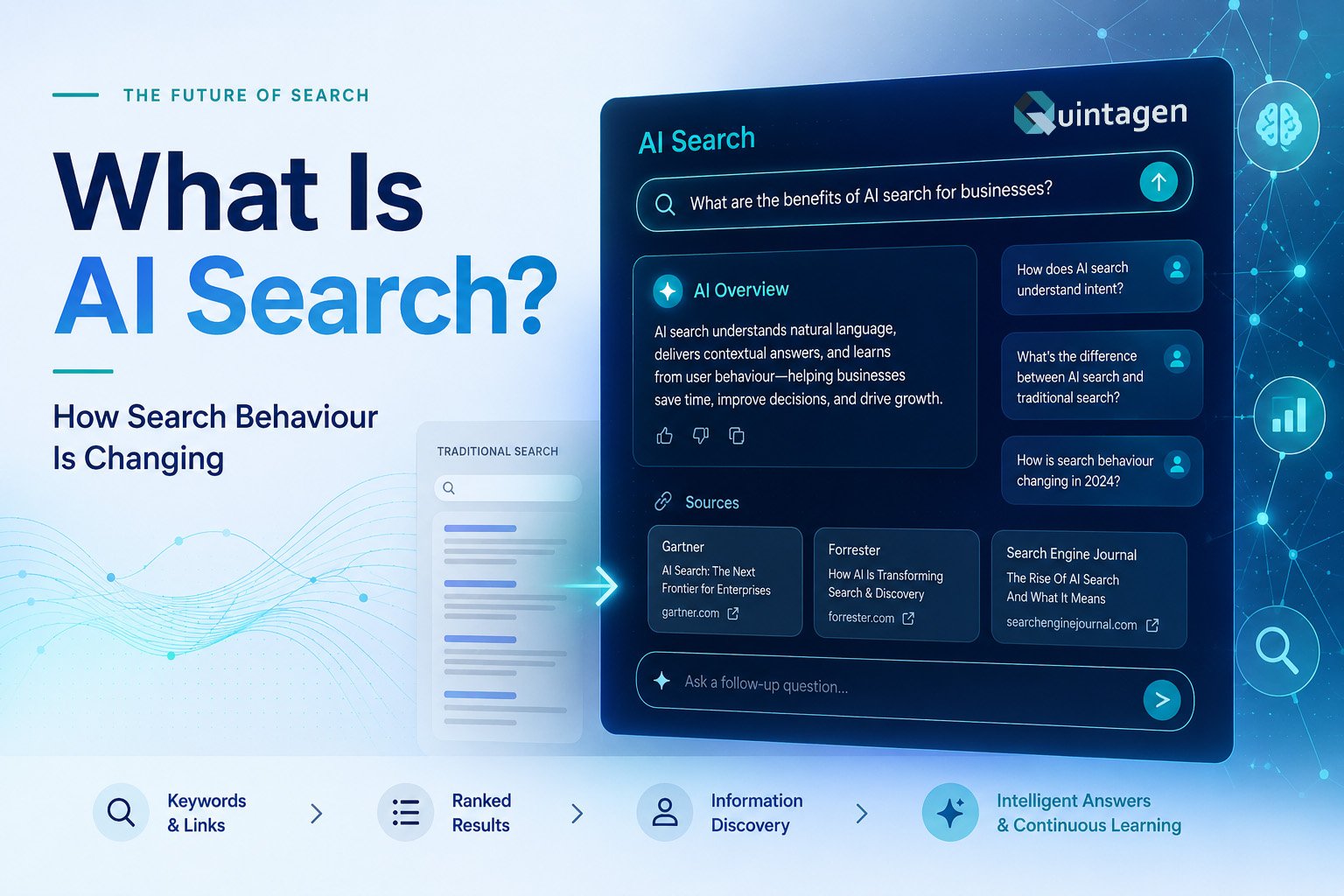
Search is changing. People still use Google to find websites, products and services, but they are also getting answers directly from search results, AI Overviews and conversational AI platforms.
As a result, three terms now appear frequently in digital marketing discussions: SEO, AEO and GEO. They are closely related, but each one emphasizes a different part of how businesses become visible online.
SEO focuses on helping content get discovered in search. AEO focuses on making information easier to understand and use as a direct answer. GEO focuses on improving how clearly a business and its content can be understood, retrieved and referenced within generative AI responses.
The important point is that businesses do not need three disconnected strategies. SEO, AEO and GEO work best as parts of the same search visibility strategy.
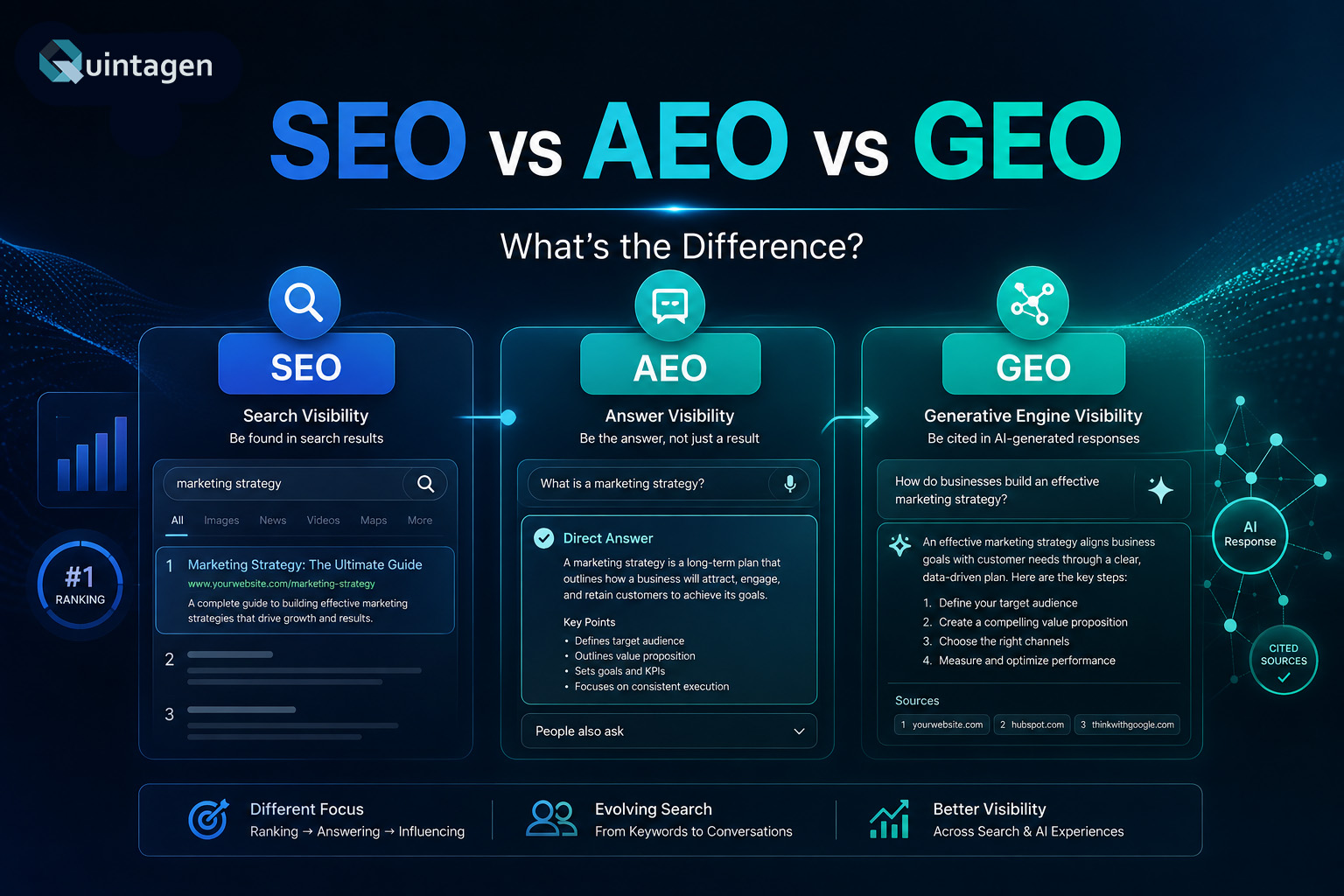
SEO vs AEO vs GEO at a Glance
| Area | SEO | AEO | GEO |
|---|---|---|---|
| Full name | Search Engine Optimization | Answer Engine Optimization | Generative Engine Optimization |
| Main goal | Improve organic search visibility | Improve answer visibility | Improve visibility in generative AI responses |
| Primary focus | Discovery, rankings and organic traffic | Clear answers to specific questions | Understanding, retrieval, mentions and citations |
| Typical search experience | Traditional search results | Featured answers, direct answers and conversational search | AI Overviews, AI assistants and generative search |
| Content emphasis | Search intent, relevance and authority | Direct, concise and well-structured answers | Context, expertise, entities and source usefulness |
| Requires SEO foundations? | Yes | Yes | Yes |
A simple way to think about the difference is:
SEO helps you get found. AEO helps you answer. GEO helps AI systems understand and reference you.
What Is SEO?
SEO, or Search Engine Optimization, is the practice of improving a website so search engines can discover, understand and rank its content for relevant searches.
SEO covers more than adding keywords to pages. It includes understanding search intent, creating useful content, improving internal linking, maintaining good website architecture, solving technical SEO issues and building signals that help search engines understand the relevance and credibility of a website.
For example, someone searching for “SEO agency Malaysia” is likely looking for a service provider, while someone searching “how long does SEO take?” is looking for information. A strong SEO strategy understands the difference and creates pages that match those different needs.
The goal is ultimately not ranking for the sake of ranking. SEO should help the right potential customers discover a business when they are searching for something relevant to what it offers.
What Is AEO?
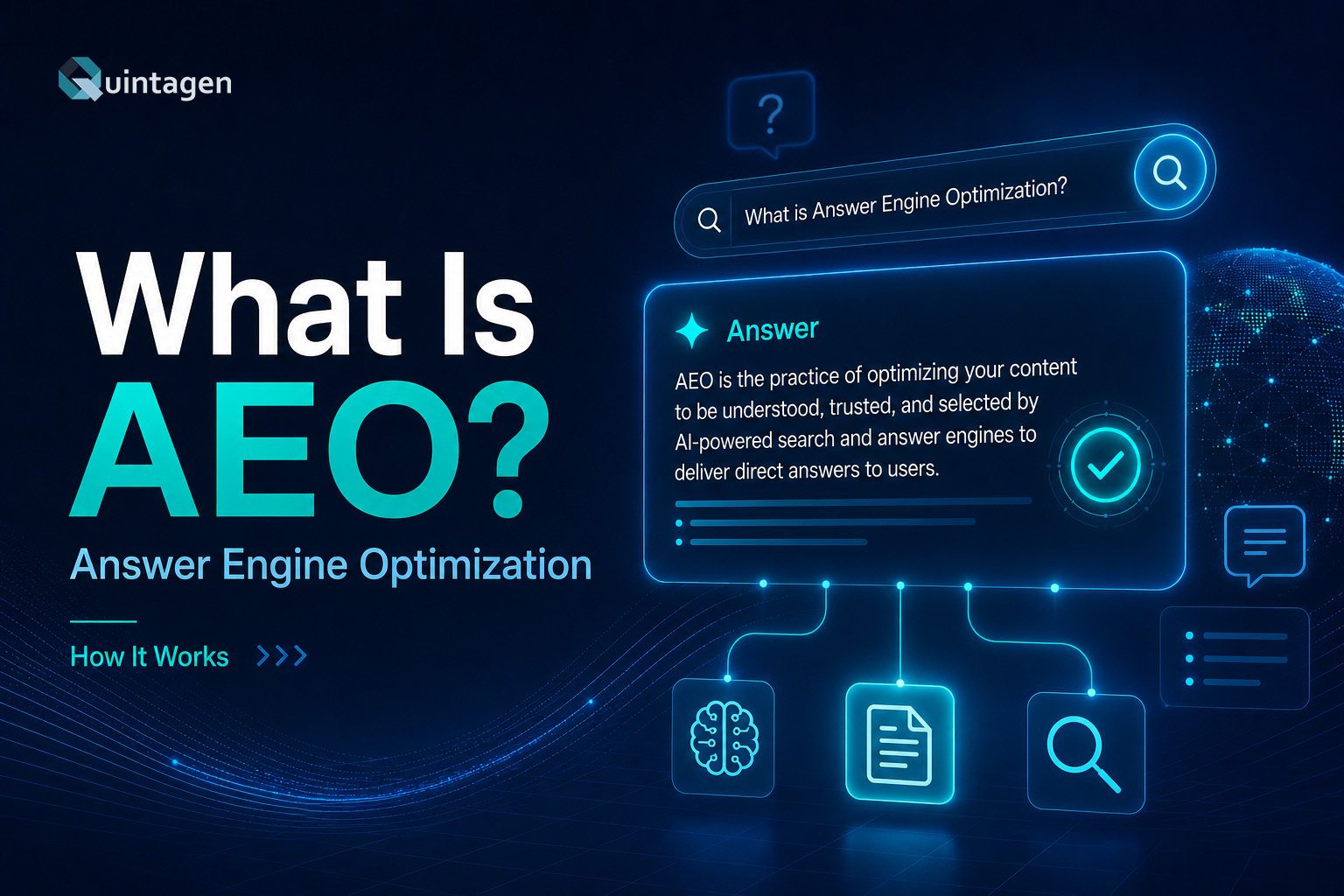
AEO, or Answer Engine Optimization, focuses on making content easier for search and AI systems to understand and present as an answer to a user’s question.
While SEO often considers the performance of an entire page, AEO pays closer attention to whether specific sections answer questions clearly. This has become more relevant as users increasingly search with complete questions and expect useful information directly within the search experience.
For example, if someone asks:
What is technical SEO?
A page that spends several paragraphs introducing a company before answering the question makes the user work unnecessarily hard. A better approach is to provide a clear definition first, followed by explanation, examples and supporting context.
AEO therefore encourages businesses to use clear headings, concise definitions, logical page structure and useful answers without turning the website into a collection of artificial question-and-answer pages.
For a deeper explanation, read our guide: What Is AEO (Answer Engine Optimization)? How It Works
What Is GEO?
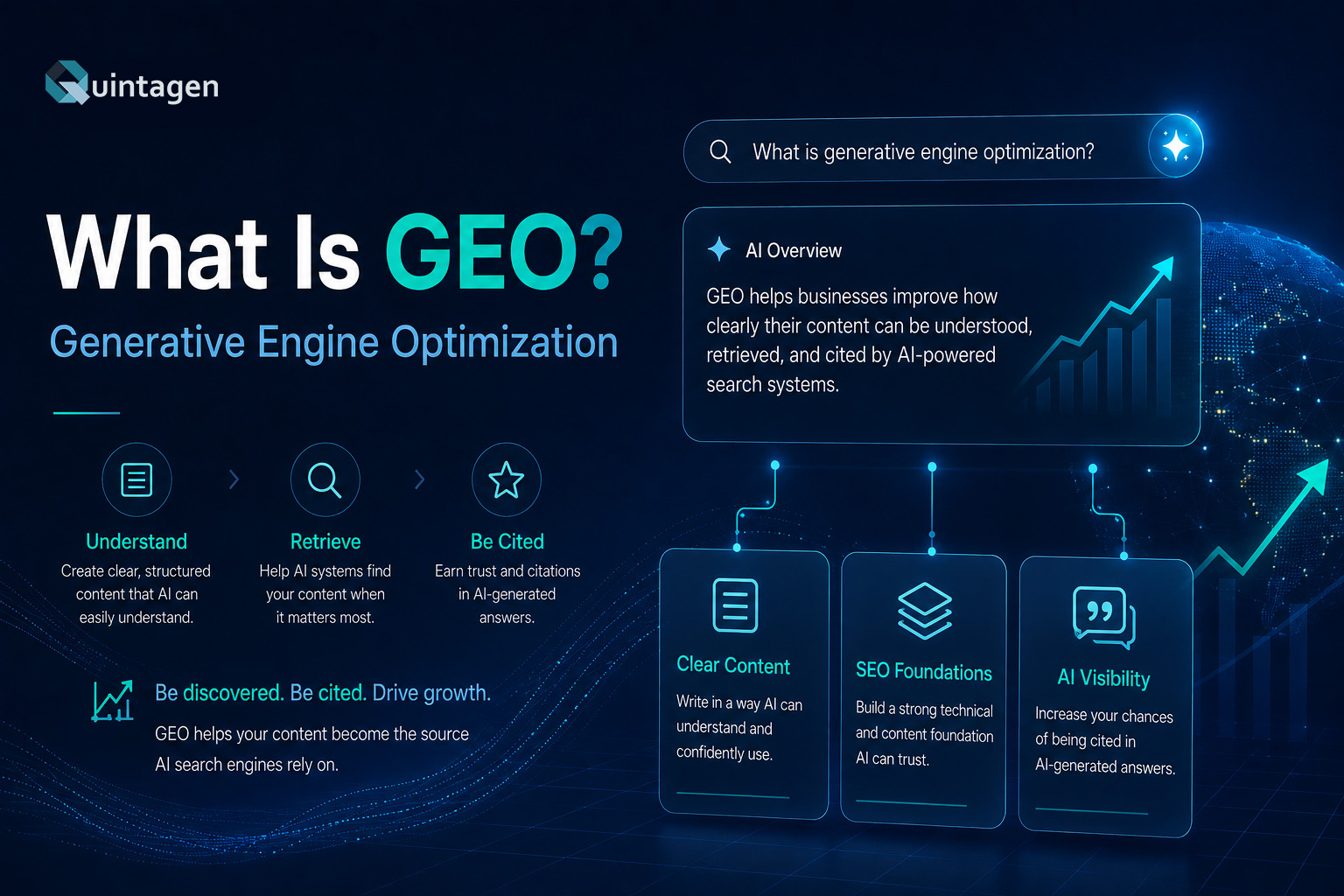
GEO, or Generative Engine Optimization, focuses on improving how clearly a business, website and its content can be understood, retrieved, referenced or cited by generative AI systems.
The difference becomes clearer when we look at how generative search can respond to a complex question.
Someone might ask:
What should a Malaysian SME look for when choosing an SEO agency?
Instead of returning only a list of websites, an AI-powered search experience may retrieve information from several sources, compare what those sources say and generate a new response. Depending on the platform, it may also reference or link to the sources that contributed useful information.
GEO therefore considers more than individual keyword rankings. It also looks at whether a website clearly explains who the business is, what it does, which topics it understands and how its different pages and areas of expertise relate to one another.
For more detail, see: What Is GEO (Generative Engine Optimization)? A Guide for Businesses
What Is the Main Difference Between SEO, AEO and GEO?
The biggest difference is the type of visibility each approach emphasizes.
SEO focuses on discoverability. It asks whether search engines can find, understand and rank your pages for relevant searches.
AEO focuses on answerability. It asks whether your content clearly answers the questions people are asking and whether important information is easy to identify.
GEO focuses on generative usefulness. It asks whether an AI system can understand the broader context of your content and potentially use that information when constructing a response.
These are not isolated objectives. A well-created page can support all three at the same time.
For example, an article explaining how much SEO costs in Malaysia could rank for relevant searches through SEO, provide direct answers to common pricing questions through AEO, and offer useful context that could potentially be retrieved by generative AI systems through GEO.
For a clearer comparison, read: SEO vs AEO vs GEO: What’s the Difference?
How Do SEO, AEO and GEO Work Together?
Consider a business that provides commercial solar installation.
From an SEO perspective, the company might create a service page targeting relevant searches such as “commercial solar installation Malaysia.” The page needs strong content, clear search intent, internal links and a technically accessible website.
The business could then strengthen its answer visibility by addressing questions potential customers commonly ask:
- How much does commercial solar installation cost?
- How long does installation take?
- What is the expected payback period?
- How much electricity can a commercial solar system generate?
Clear answers to these questions support AEO because the information becomes easier for both users and search systems to understand.
GEO looks at the broader information environment. If the same website also contains useful, connected information about commercial solar systems, installation, financing, maintenance, regulations and energy savings, AI systems have more context for understanding what the company knows and what its content is about.
In this example, the work is connected rather than separate. SEO improves discovery, AEO improves answer clarity, and GEO strengthens the context and usefulness of the information for generative search.
Do AEO and GEO Replace SEO?
No. AEO and GEO build on many of the same foundations that make good SEO work.
A page still benefits from being crawlable, indexable, logically structured and connected through useful internal links. Content still needs to match user intent and provide information that is genuinely worth finding.
Google’s current guidance for its AI search features reflects this as well. Its AI features continue to rely on the same fundamental SEO requirements, without requiring a separate set of special AI-only technical optimizations.
This is why abandoning SEO to focus only on AEO or GEO would be the wrong approach. A better strategy is to evolve SEO so it also considers how people search through answers and generative AI experiences.
We will explore this subject in more depth in our upcoming article, Does SEO Still Matter in the Age of AI Search?
Which Should Businesses Prioritize?
For most businesses, the sensible starting point is still a strong SEO foundation.
First, make sure the website can be discovered and understood properly. Important service pages should be accessible, the website architecture should make sense, internal links should connect related content and pages should address meaningful customer search intent.
Once those foundations are in place, improve how clearly the website answers customer questions. Important information should not be buried behind vague introductions or unnecessary marketing language. Definitions, explanations, comparisons and FAQs should be easy to understand while still providing enough context for someone who wants more detail.
The next step is to look at the website as a broader information source. Is it clear what the company does? Are its services well explained? Does it have meaningful depth around the subjects it claims expertise in? Are related pages connected in a way that helps users and search systems understand those relationships?
That progression allows SEO, AEO and GEO to develop together rather than competing for attention.
Common Mistakes When Approaching SEO, AEO and GEO
One common mistake is treating SEO, AEO and GEO as three unrelated marketing programmes. This often creates duplicated content and unnecessary work when the same strong page could support multiple types of visibility.
Another mistake is abandoning SEO because AI search is growing. Search technology may be changing, but websites still need strong technical foundations, useful content and clear information architecture.
Businesses should also avoid writing purely for AI systems. Content that sounds unnatural, repetitive or excessively optimized is unlikely to create a good experience for the people the website is supposed to attract.
Finally, avoid focusing too heavily on terminology. Whether a particular improvement is labelled SEO, AEO or GEO matters less than whether it helps the right customer find, understand and trust the business.
Quintagen's Approach to SEO, AEO and GEO
At Quintagen, we see SEO, AEO and GEO as connected parts of a wider digital visibility and business growth strategy.
SEO creates the foundation for discovery. AEO improves how clearly important information answers customer questions. GEO extends that thinking into generative search by making the business, its expertise and its content easier to understand within a broader context.
These areas also connect closely with content strategy, technical SEO, website architecture, website development, user experience and digital marketing. A website may gain more visibility, but that visibility has limited business value if visitors cannot understand the offer or do not take the next step.
Our focus is therefore not simply on rankings or appearing in AI-generated answers. The broader objective is to improve visibility, attract relevant audiences and create a stronger digital journey that can contribute to enquiries, conversions and business growth.
Frequently Asked Questions
What is the difference between SEO, AEO and GEO?
SEO focuses on helping content become discoverable in search. AEO focuses on making information easier to understand and use as a direct answer, while GEO focuses on improving how a business and its content can be understood and referenced within generative AI search experiences.
Does AEO replace SEO?
No. AEO complements SEO by improving answer clarity, but it still relies heavily on SEO fundamentals such as crawlability, indexing, useful content and good website structure.
Does GEO replace SEO?
No. GEO extends search optimization into generative AI environments. Strong SEO foundations remain important for helping content become accessible, understandable and useful.
Which should a business focus on first?
Most businesses should establish strong SEO foundations first, then improve answer clarity through AEO principles and strengthen broader business and topical context for GEO.
Can one page be optimized for SEO, AEO and GEO?
Yes. A useful page can satisfy search intent, provide clear answers and give AI systems enough context to understand the subject at the same time. Businesses generally do not need separate versions of the same page for SEO, AEO and GEO.
Final Thoughts
SEO, AEO and GEO describe different aspects of how search visibility is evolving.
SEO remains the foundation for helping relevant content become discoverable. AEO improves how clearly that content answers specific questions, while GEO considers how well the business and its information can be understood and used in generative search environments.
The strongest approach is not to choose one and ignore the others. It is to create a technically sound website with useful content, clear answers, strong topical relationships and an obvious connection between what the business knows and what it offers.
That creates a stronger foundation for visibility across traditional search, answer-driven search and AI-powered search.