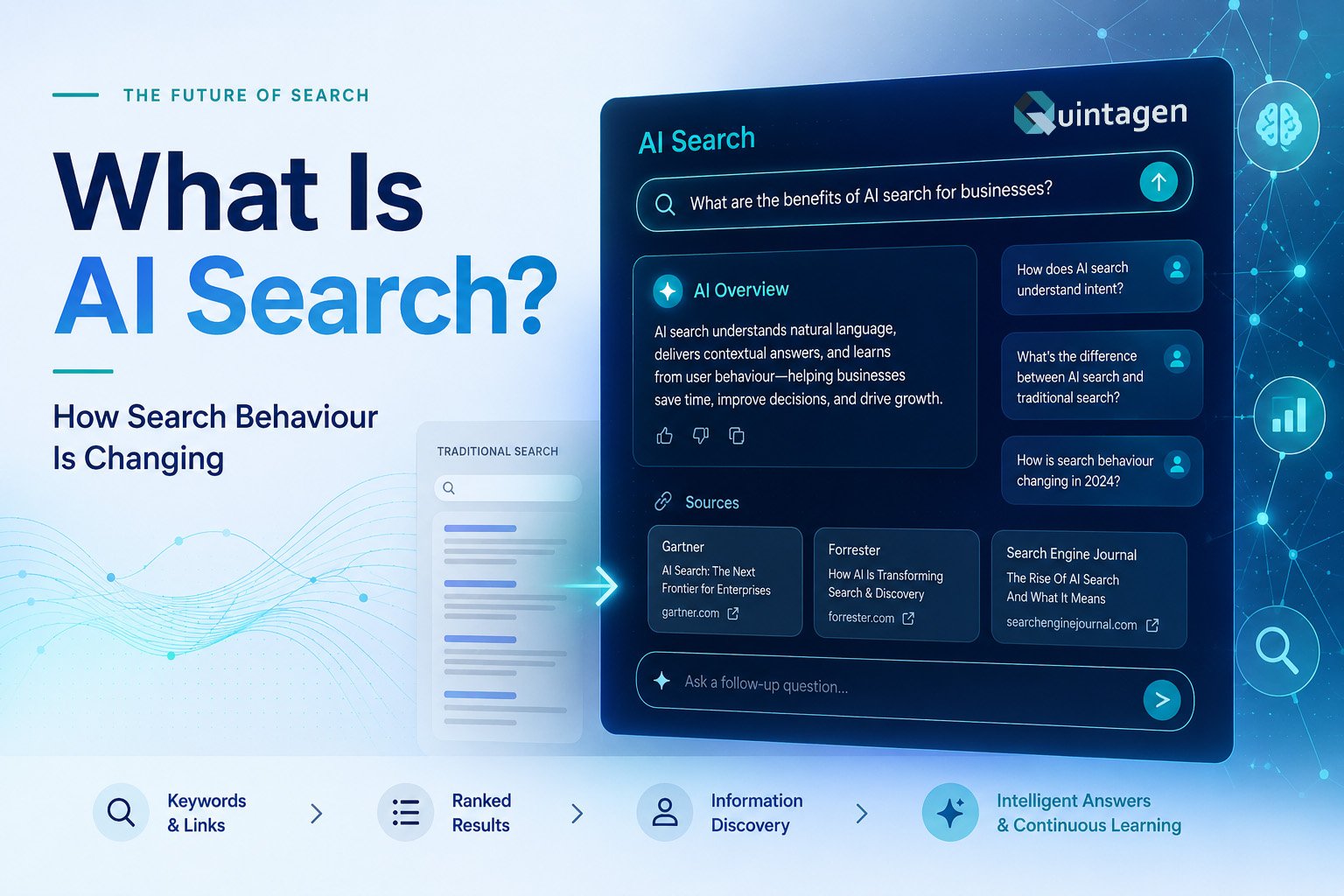
Search is becoming more answer-driven.
People still type keywords into Google, but they increasingly search using complete questions, voice assistants, AI-powered search experiences and conversational interfaces.
Instead of always clicking through several websites to find information, users may receive an answer directly within the search experience.
For businesses, this creates an important question:
How can you make your content easier for search engines and AI systems to use when answering a user’s question?
This is where Answer Engine Optimization, or AEO, comes in.
What Is Answer Engine Optimization (AEO)?
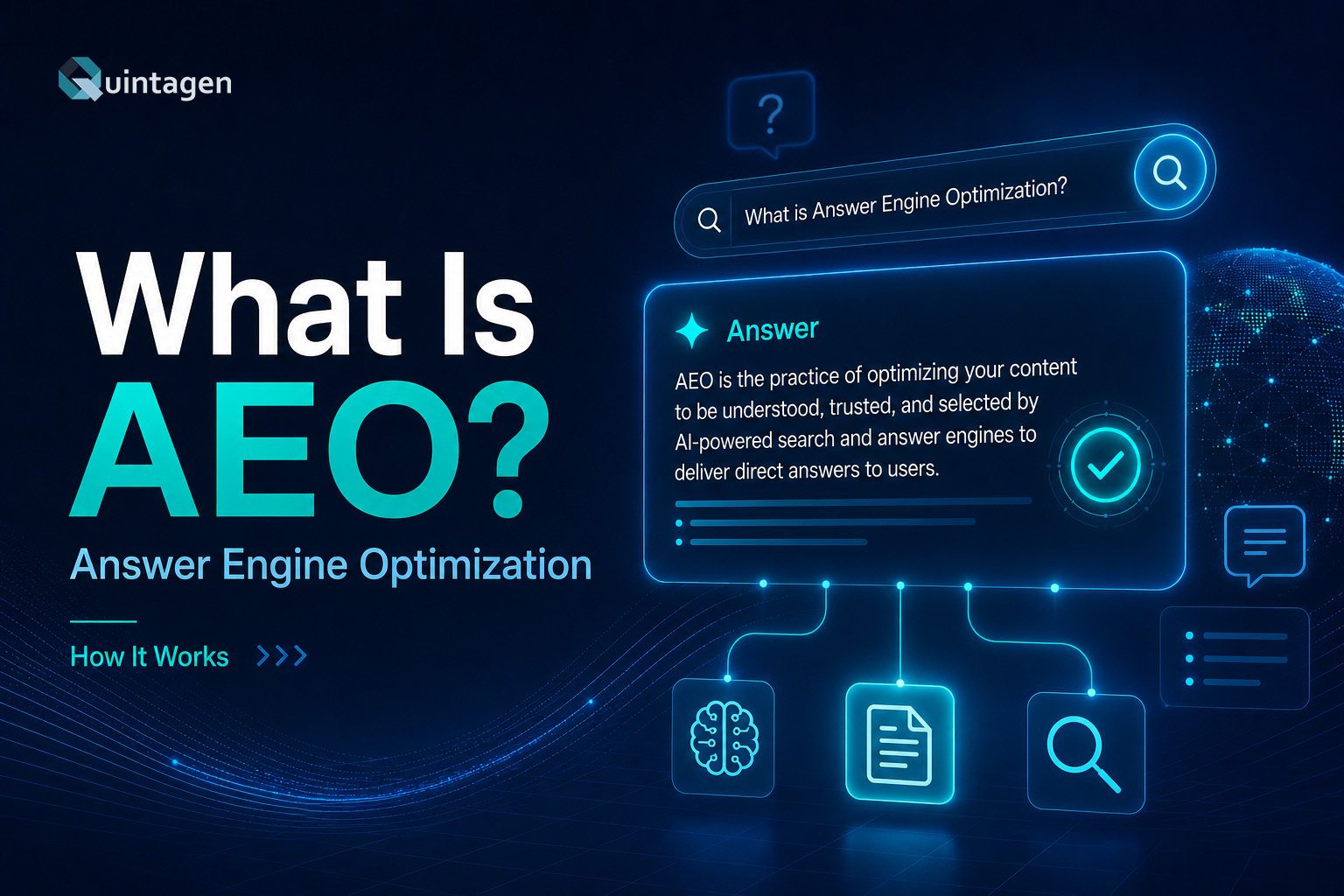
Answer Engine Optimization (AEO) is the practice of structuring and improving content so search engines and AI-powered systems can easily understand, extract and present it as a useful answer to a user’s question.
AEO focuses on making information:
- clear
- direct
- relevant to the question
- easy to understand
- well structured
- supported by useful context
- accessible to search systems
The goal is not simply to rank a page.
It is to make the information on that page suitable for answering specific questions.
What Is an Answer Engine?
An answer engine is a search or AI system that attempts to provide a direct response to a user’s question instead of only presenting a list of websites.
Examples of answer-driven search experiences can include:
- featured snippets
- People Also Ask results
- voice assistant responses
- AI-generated search summaries
- conversational search interfaces
- AI assistants that retrieve information from the web
The boundaries between traditional search engines, answer engines and generative AI systems are becoming less distinct.
A modern search experience may rank websites, extract individual passages, generate summaries and recommend additional sources within the same results page.
This is why businesses should think beyond individual search features and focus on making their information genuinely useful and understandable.
How Does AEO Work?
A simplified answer-search process may look like this:
- A user asks a question.
- The search or AI system interprets what the user wants to know.
- Relevant pages or information are identified.
- The system determines which information best addresses the question.
- A direct answer, summary or result is presented to the user.
- Supporting sources or links may also be displayed.
AEO improves the conditions that help your content participate in this process.
For example, imagine someone searches:
How long does SEO take to work?
A page that begins with several paragraphs of company background before addressing the question may be less useful to both the reader and the search system.
A clearer approach would be:
SEO commonly takes several months to produce meaningful results, although the timeline depends on factors such as competition, website condition, content quality and the market being targeted.
The direct answer appears first.
The page can then explain the factors, exceptions and details underneath.
That is a simple example of answer-oriented content.
Why Is AEO Important?
Search behaviour has become more conversational.
Instead of searching only:
SEO Malaysia
A potential customer might ask:
How much should a Malaysian business budget for SEO?
Or:
Is SEO or Google Ads better for a new B2B company?
These questions contain much more intent.
Users are not simply looking for pages containing a keyword. They want a useful answer that helps them understand something or make a decision.
Businesses therefore need content that does more than target phrases.
It should answer real customer questions clearly.
AEO can help businesses improve the way their expertise is represented across increasingly answer-driven search experiences.
AEO vs SEO: What Is the Difference?
There is significant overlap between AEO and SEO, but each places emphasis on a different part of search visibility.
| SEO | AEO |
|---|---|
| Focuses on organic search visibility | Focuses on answer visibility |
| Targets topics, keywords and search intent | Targets specific questions and information needs |
| Aims to improve rankings, impressions, clicks and conversions | Aims to make information easy to identify and present as an answer |
| Optimizes entire pages and websites | Often pays particular attention to answer-ready sections and passages |
| Includes technical SEO, content, links and authority | Relies on those SEO foundations while improving answer clarity |
Instead, it should complement strong SEO foundations.
Before its information can be useful to a search system, a page still needs to be discoverable.
Therefore, crawlability, indexing, website structure, internal linking, authority and content quality continue to matter.
For a clearer comparison, read: SEO vs AEO vs GEO: What’s the Difference?
AEO vs GEO: What Is the Difference?
There is considerable overlap between AEO and GEO, but they serve different purposes within modern search.
AEO focuses on answers
Answer Engine Optimization concentrates on making individual pieces of information easy to identify, understand and present as direct answers.
GEO focuses on generative responses
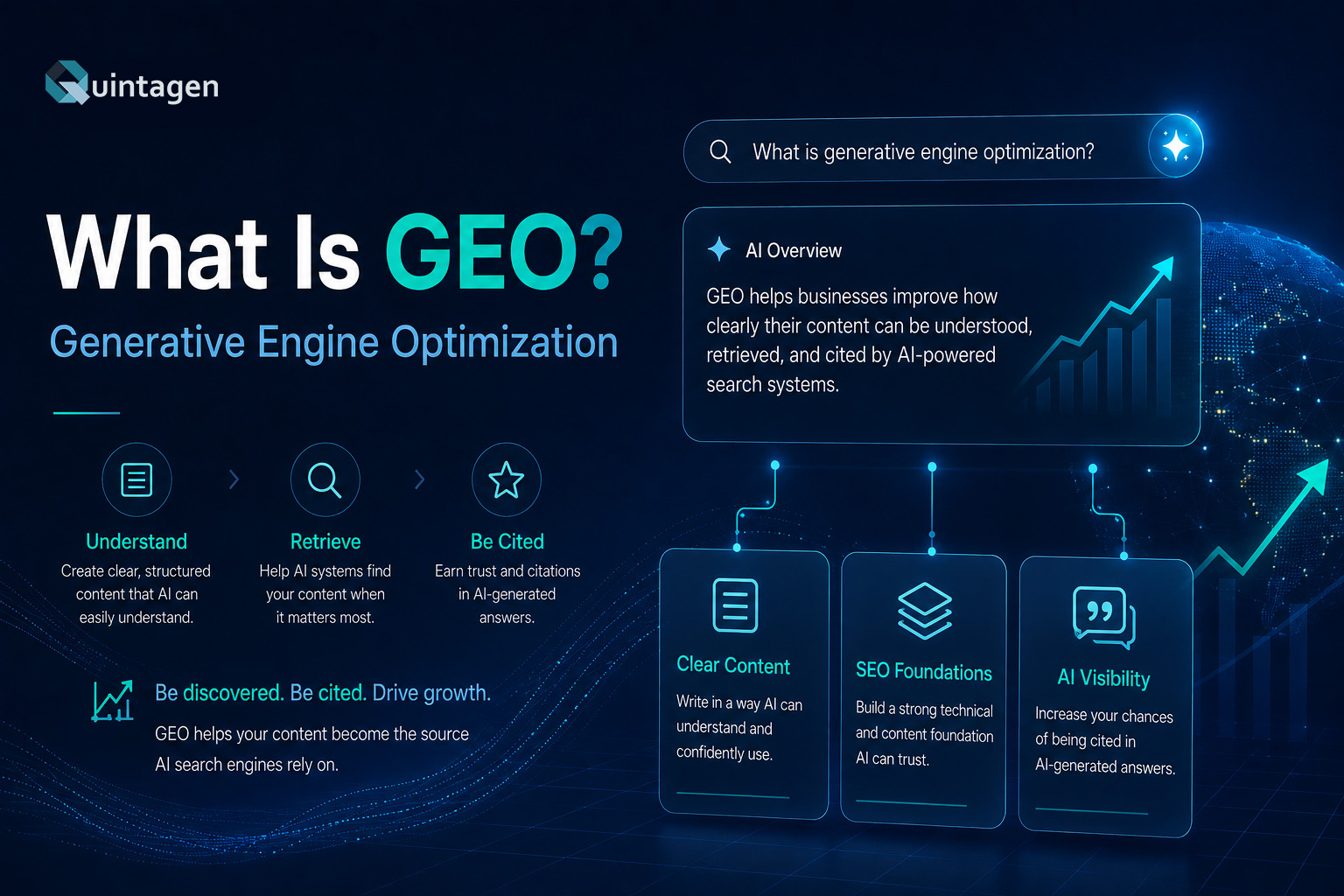
Generative Engine Optimization focuses more broadly on how a website, business, brand or source may be understood, retrieved, referenced or cited within AI-generated responses.
A simple way to view the relationship is:
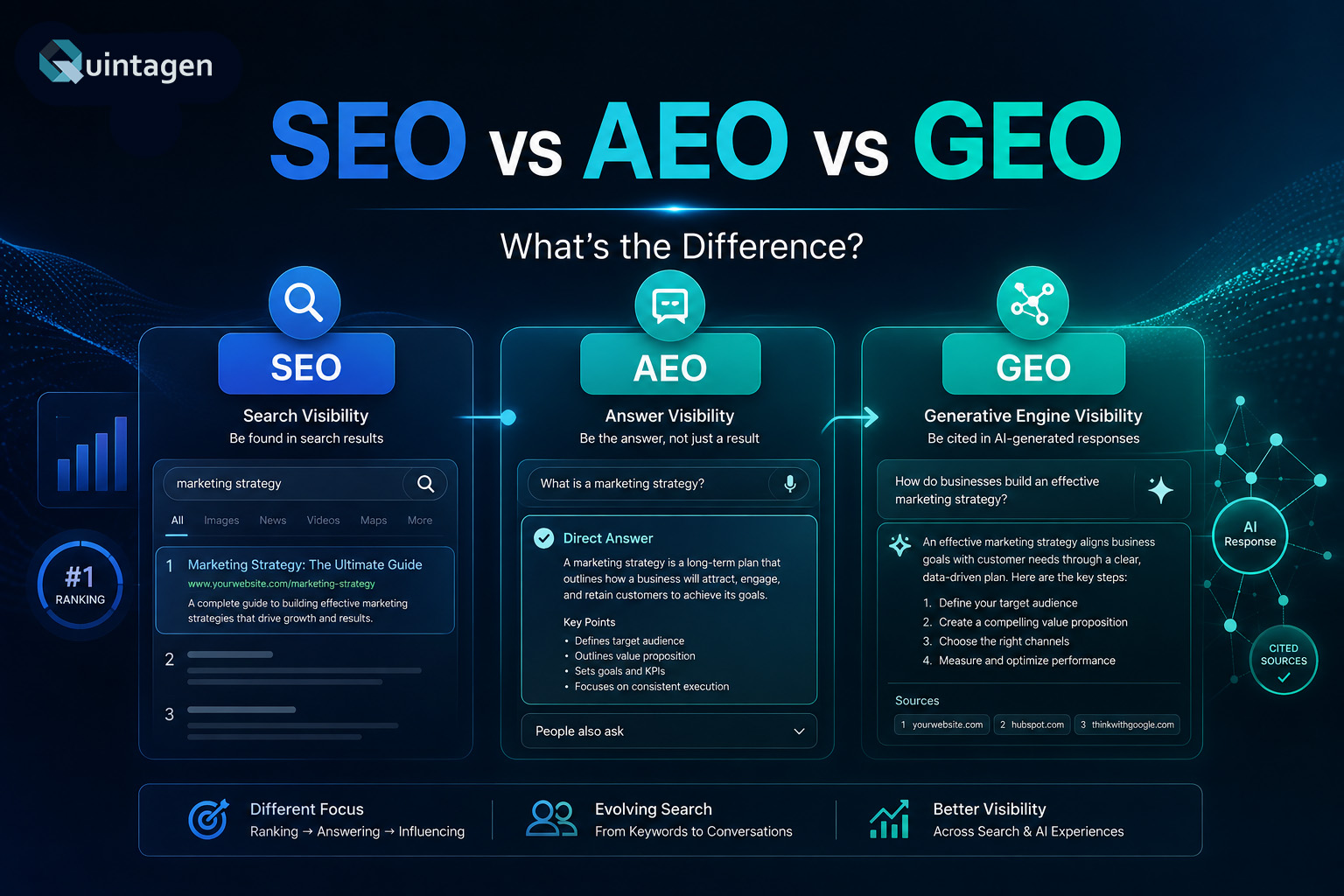
SEO = Search visibility
AEO = Answer visibility
GEO = Generative visibility
These areas overlap.
A well-structured answer may support AEO while also making the same content easier to interpret within generative AI systems.
Businesses therefore do not need three completely separate content strategies.
They need one strong search and content foundation designed for the way people now find information.
What Types of Content Work Well for AEO?
AEO is particularly relevant when users have clear questions.
Common formats include:
Definitions
Examples:
- What is SEO?
- What is AEO?
- What is GEO?
- What is technical SEO?
Definitions should usually answer the question immediately before moving into deeper explanation.
How-to questions
Examples:
- How do I improve my Google ranking?
- How do I optimize a website for AI search?
- How do I reduce website loading time?
These pages benefit from logical steps and clear instructions.
Comparison questions
Examples:
- SEO vs Google Ads: which is better?
- AEO vs GEO: what is the difference?
- WordPress vs custom website development: which should I choose?
Comparison tables and clearly defined criteria can make these pages easier to understand.
Decision questions
Examples:
- How do I choose an SEO agency?
- How much should SEO cost?
- Is SEO worth it for a small business?
These questions often appear later in the customer journey and can influence purchasing decisions.
Frequently asked questions
FAQs can address specific questions that do not require an entire article of their own.
However, FAQ sections should be created because the questions are genuinely useful to customers, not simply to add more keywords to a page.
How Can Businesses Optimize Content for AEO?
There is no single AEO setting that automatically creates answer visibility.
Businesses should instead focus on making their content clearer and more useful.
1. Identify the questions customers actually ask
Start with customer intent rather than keywords alone.
Useful questions may come from:
- sales conversations
- customer enquiries
- support questions
- Search Console queries
- keyword research
- People Also Ask results
- industry discussions
- questions asked during project consultations
A company with real customer experience often already has a valuable source of content ideas.
The questions customers repeatedly ask are often exactly the questions your website should answer.
2. Answer the question early
Avoid forcing readers to scroll through several paragraphs before receiving the information they came for.
For a question-based section, try this structure:
Question
Direct answer
Supporting explanation
Examples or additional context
For example:
Does AEO replace SEO?
No. AEO works alongside SEO. SEO helps content become discoverable, while AEO improves how clearly that content answers specific questions.
The reader receives the answer immediately.
Additional detail can then follow.
3. Use question-based headings where appropriate
Headings help readers scan a page and help clarify its structure.
Useful headings might include:
- What is AEO?
- How does AEO work?
- Does AEO replace SEO?
- What is the difference between AEO and GEO?
- How do you measure AEO?
Do not convert every heading into a question simply for optimization.
Use questions when they reflect how people naturally search or think about the subject.
4. Keep answers concise before adding detail
A direct answer does not have to be the entire explanation.
Think of the first paragraph as the summary.
Then provide additional context.
For example:
AEO helps businesses structure information so search and AI systems can more easily identify and present it as an answer.
After this definition, you can explain how AEO relates to SEO, content structure, search intent and AI-powered search.
This allows the same section to serve users who want a quick answer and users who want deeper information.
5. Make your website easy to understand
AEO is not limited to individual blog posts.
Search systems also need context about the business behind the information.
Your website should clearly communicate:
- company name
- services
- expertise
- customers you serve
- industries where relevant
- operating locations
- contact information
- relationships between services and content
A vague website makes interpretation more difficult.
Specific information is more useful than broad marketing statements.
6. Create logical content structures
Use:
- descriptive titles
- clear H2 and H3 headings
- short paragraphs
- lists where useful
- comparison tables where appropriate
- descriptive internal links
- focused sections
Structure should improve comprehension rather than simply make the page appear optimized.
7. Build content around related questions
One article should not try to answer every possible question about a broad subject.
Instead, build connected content.
For example, Quintagen’s AI search content cluster may include:
- What Is GEO?
- What Is AEO?
- SEO vs AEO vs GEO
- What Is AI Search?
- How to Optimize Your Website for AI Search
- How Do AI Search Engines Choose Sources?
- How to Measure AI Search Visibility
Each page can answer a distinct question while linking to relevant supporting content.
This builds useful topical depth without creating repetitive pages.
8. Support important answers with credible information
When an answer involves data, technical claims or changing information, provide appropriate support.
That may include:
- official documentation
- research
- statistics
- original data
- first-hand experience
- case studies
- practical examples
An answer that sounds confident is not necessarily a trustworthy answer.
Credibility matters.
9. Maintain strong technical SEO
AEO still requires a technically accessible website.
Important foundations include:
- crawlability
- indexability
- mobile accessibility
- page performance
- HTTPS
- internal linking
- canonical implementation
- clean website architecture
- appropriate structured data
Content cannot contribute effectively to search visibility if search engines cannot access or understand the page.
10. Use structured data appropriately
Structured data can provide search engines with additional machine-readable information about a page.
For example, relevant structured data may include types such as:
- Article
- BlogPosting
- Organization
- LocalBusiness
- Product
- Service
- BreadcrumbList
The correct type depends on the content.
More importantly, structured data should accurately represent information that is actually visible on the page. It should therefore not be treated as a shortcut to answer visibility. There is no need to add unnecessary schema simply because a page is being optimized for AEO.
11. Keep important information current
An outdated answer can quickly become a poor answer.
Review content when:
- search platforms change
- regulations change
- pricing or services change
- software changes
- market conditions change
- new information makes an existing explanation inaccurate
Displaying a meaningful last-updated date can also help users understand how current the information is.
Does AEO Help With Featured Snippets?
Potentially.
Featured snippets are one example of an answer-oriented search result.
Google may select part of a webpage and display it prominently when its systems determine that the passage provides a useful answer to a search query.
However, websites cannot simply mark a section as a featured snippet or guarantee that Google will select it.
This makes the correct objective:
Create a genuinely strong answer first.
Do not write awkward or artificial content purely to chase a snippet.
Does AEO Help With AI Search?
AEO can support AI search visibility because clear answers are easier to interpret than vague or poorly structured information.
However, AEO and AI visibility should not be treated as identical concepts.
Generative AI systems may need to do more than extract one answer.
For example, they may combine information from multiple sources, compare alternatives, evaluate context and generate a new response.
This broader area is where GEO becomes increasingly relevant.
For businesses, the most practical strategy is to make content both: answer-ready and context-rich.
The answer should be clear, but the page should also contain enough useful supporting information for a reader or system to understand the wider topic.
To understand the wider shift behind these experiences, see our guide to what AI search is and how search behaviour is changing.
Can AEO Help With Voice Search?
Potentially.
For example, Voice searches are often phrased as natural questions:
- What is technical SEO?
- How much does a website cost in Malaysia?
- Which digital marketing strategy is best for B2B?
- How long does SEO take?
Clear question-and-answer content can therefore be useful for voice-driven search experiences.
However, businesses should not create unnatural pages specifically for voice search.
Good conversational content usually works across multiple search experiences.
How Is AEO Measured?
AEO does not have one universal metric.
Businesses can monitor indicators such as:
- featured snippet appearances
- People Also Ask visibility
- impressions for question-based searches
- rankings for informational queries
- organic clicks
- pages receiving answer-oriented search traffic
- AI or generative search visibility where relevant
- engagement with informational content
- conversions influenced by informational pages
Not every successful answer produces an immediate click.
For this reason, AEO should be evaluated as part of a broader search visibility and customer journey strategy.
Common AEO Mistakes
Writing artificial question-and-answer content
Do not add dozens of low-value questions simply because users might search for them. Instead, every answer should have a useful purpose.
Giving vague answers
If a heading asks a clear question, answer it.
Avoid beginning with several sentences that simply restate the question.
Repeating the same keywords
AEO is not about repeatedly inserting phrases such as “what is AEO” throughout the article.
Write naturally.
Creating one page for every question variation
These searches:
- What is AEO?
- What does AEO mean?
- What is Answer Engine Optimization?
share essentially the same intent.
They generally do not need separate articles.
Ignoring technical SEO
Answer-friendly content still needs to be accessible and discoverable.
Using structured data as a shortcut
Schema can help provide machine-readable context, but adding markup does not guarantee a direct answer or search feature.
Publishing generic AI-generated content
A page that simply repeats information already available everywhere else offers little reason for people or search systems to prefer it.
Add expertise, context, examples and useful perspectives.
Optimizing only for machines
The best answer is ultimately the answer that helps the person asking the question.
Readability and usefulness come first.
A Practical AEO Framework
Businesses can begin improving answer visibility with this process:
- Identify important questions customers ask.
- Group questions by topic and search intent.
- Decide which questions require dedicated pages and which belong within existing content.
- Use clear headings.
- Give the direct answer early.
- Add useful supporting explanation.
- Include examples where they improve understanding.
- Support important claims with credible information.
- Link related topics together.
- Maintain strong technical SEO.
- Keep answers accurate and current.
- Monitor search performance and improve content over time.
The goal is not to produce as many answers as possible. Instead, the priority is to become a useful source for the questions that matter to your customers.
How Quintagen Approaches AEO
At Quintagen, we see AEO as part of a wider search visibility and digital growth strategy.
Optimizing a paragraph for a direct answer has limited value if the website itself is difficult to crawl, poorly structured or unclear about the business behind the content.
Our broader approach connects areas such as:
- Search Engine Optimization
- Answer Engine Optimization
- Generative Engine Optimization
- content strategy
- technical SEO
- website structure
- website development
- digital marketing
These areas support one another.
SEO helps make information discoverable.
AEO helps make important information easier to answer from.
GEO helps extend visibility into generative AI search experiences.
Strong website and technical foundations support all three.
The objective is not simply to appear in more search features.
It is to help businesses become easier to find, easier to understand and better positioned to turn digital visibility into meaningful enquiries and growth.
Frequently Asked Questions About AEO
What does AEO stand for?
AEO stands for Answer Engine Optimization. It is the practice of improving content so search engines and AI systems can more easily understand, extract and present it as an answer to a user’s question.
What is AEO in digital marketing?
In digital marketing, AEO focuses on improving a business’s visibility in answer-oriented search experiences by creating clear, useful and well-structured information around the questions customers ask.
Is AEO the same as SEO?
No.
SEO focuses broadly on organic search visibility, while AEO focuses more specifically on making information suitable for direct answers.
AEO depends heavily on strong SEO foundations.
Does AEO replace SEO?
No.
AEO should complement SEO.
A page still needs to be crawlable, indexable, relevant and authoritative before answer optimization becomes meaningful.
What is the difference between AEO and GEO?
AEO focuses primarily on direct answers.
GEO focuses more broadly on how information and brands can be understood, retrieved, referenced or cited within generative AI responses.
The two areas overlap.
Is structured data required for AEO?
No single schema type is required for AEO.
Structured data should be used where it accurately describes the visible content and is appropriate for the page.
Can AEO guarantee a featured snippet?
No.
Search engines determine which content appears in featured snippets and other answer features.
AEO can improve content clarity, but it cannot guarantee placement.
How do I start optimizing for AEO?
Start with the real questions your customers ask.
Create clear answers, use logical headings, add useful supporting information, maintain strong SEO fundamentals and connect related content through internal links.
Final Thoughts
Search is no longer only about ranking a webpage for a keyword.
Increasingly, search systems are trying to understand the question behind the query and provide useful information more directly.
AEO prepares businesses for this shift.
The core principle is simple:
Understand the question. Answer it clearly. Support the answer with useful information.
SEO helps your content become discoverable.
AEO helps your content become answerable.
GEO helps your business and expertise become useful within generative search.
Together, they form a stronger approach to search visibility as the way people find information continues to evolve.