Search is becoming more conversational.
For many years, searching online usually meant typing a short keyword into Google, scanning a list of results and opening several websites to find the information you needed.
That behaviour is changing.
Search engines and AI assistants can now interpret longer questions, combine information from multiple sources and provide a direct response before a user visits a website. People can also continue the conversation with follow-up questions instead of starting a completely new search each time.
This shift is commonly described as AI search.
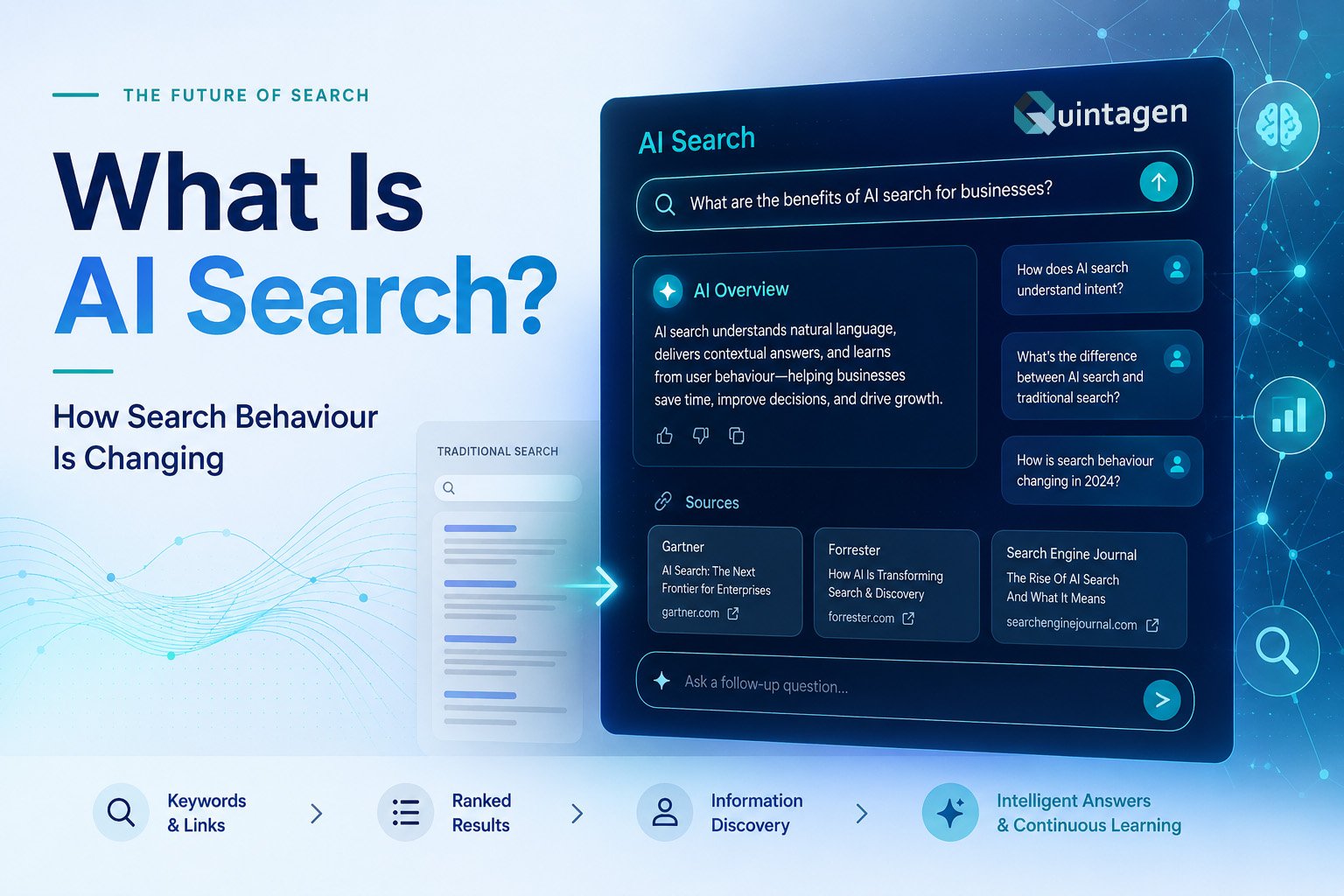
AI search uses artificial intelligence to understand a user’s question, retrieve relevant information and provide a more direct or conversational response, often supported by links or citations to web sources.
It does not mean traditional search has disappeared. Instead, search is evolving from simply finding pages to increasingly helping users understand information, compare options and make decisions.
What Is AI Search?
AI search refers to search experiences that use artificial intelligence to better understand queries and generate or organize answers.
Traditional search engines mainly became known for returning ranked lists of web pages. Modern AI-powered search experiences can go further by interpreting the meaning behind a question, retrieving information from different sources and presenting that information in a summarized response.
Examples include Google’s AI Overviews and AI Mode, as well as conversational tools such as ChatGPT Search. Google describes AI Mode as particularly useful for questions involving deeper exploration, reasoning and complex comparisons, while ChatGPT Search can search the web and provide responses with links to relevant sources.
A user might traditionally search:
best CRM software Malaysia
With AI search, the same person might ask:
What CRM would be suitable for a Malaysian B2B company with a 10-person sales team that needs WhatsApp integration and does not want an expensive enterprise system?
The second query gives the search system much more context about what the user actually needs.
Traditional Search vs AI Search
| Traditional Search | AI Search |
|---|---|
| Often starts with shorter keywords | Often supports longer, natural questions |
| Primarily presents search results | May generate a direct answer or summary |
| Each search may be relatively independent | Follow-up questions can retain context |
| Ranking positions are highly visible | Sources may appear within or alongside a generated response |
| Research often happens across multiple tabs | More research can happen within one conversation |
This distinction is important because it changes how people discover and evaluate information.
The search may still use web pages behind the scenes, but users are not always interacting with those pages in the same way.
How Does AI Search Work?
Different AI search platforms use different technologies, so there is no single process that applies to every system.
At a simple level, an AI-powered search experience may:
- understand the user’s question and intent
- identify related concepts or subtopics
- retrieve relevant information
- evaluate information from different sources
- generate or organize a response
- provide links, citations or further ways to explore the topic
For more complicated questions, this can involve several searches behind the scenes.
Google, for example, says AI Overviews and AI Mode may use a technique it calls query fan-out, where multiple related searches are performed across different subtopics and data sources to build a response.
This helps explain why optimizing only for one exact keyword becomes less useful as search questions become more detailed.
How Is AI Search Changing Search Behaviour?
The bigger change is not simply that search engines are adding AI. People are also changing the way they ask for information.
People are asking longer and more specific questions
Traditional keyword searches often remove unnecessary words:
commercial solar cost Malaysia
AI search makes it more natural to ask:
How much should a medium-sized factory in Malaysia expect to spend on commercial solar, and what affects the payback period?
The second search communicates the user’s situation and expected answer much more clearly.
Google reported in May 2026 that the average AI Mode query in the United States was around three times the length of a traditional Search query.
For businesses, this means search strategy increasingly needs to consider topics, questions, context and customer problems, not just short keyword phrases.
Search is becoming more conversational
Previously, someone researching SEO might perform a series of separate searches:
what is SEO
SEO agency Malaysia
SEO price Malaysia
how long does SEO take
SEO vs Google Ads
With conversational AI search, these questions can become part of the same interaction.
A user could begin by asking:
Should a small B2B company invest in SEO?
Then continue with:
How long would it take?
Followed by:
Would Google Ads be better for the first six months?
Because the conversation retains context, users can move from general research toward a purchasing decision without repeatedly starting from the beginning.
Users can search with more than text
Search is also becoming increasingly multimodal.
People can search using images, voice and other forms of input rather than relying entirely on typed keywords. Google reported in May 2026 that more than one in six searches in the United States were already using voice or images.
This creates new ways for customers to discover products, places, services and information.
More of the research process can happen before a website visit
Traditional search often required users to visit several websites to understand a subject.
AI search can summarize some of that information before the user clicks. For example, someone comparing different website platforms might ask an AI search system to explain the advantages and disadvantages of WordPress, Shopify and Webflow for their particular business.
The response may already contain enough information to eliminate one or two options. By the time the person visits a company website, they may be further along in their decision-making process than a traditional search visitor.
This means businesses should think about more than simply generating clicks. They also need to consider whether their information can contribute to the research and decision process itself.
Does AI Search Mean Websites Will Become Less Important?
No.
AI search still relies heavily on information available across the web. Google’s AI search features provide links to websites, while ChatGPT Search also provides source links within responses.
However, the role of a website may change. A website is not only a destination someone visits after seeing a search result. It is also an information source that search and AI systems may use to understand a company, its services and its expertise.
For businesses, that makes clarity increasingly important.
A website should make it easy to understand:
- who the company is
- what it provides
- which problems it solves
- where it operates
- what subjects it has expertise in
- how its services and content relate to each other
These fundamentals benefit users, traditional search engines and AI-powered search experiences at the same time.
What Does AI Search Mean for SEO?
AI search does not mean businesses should stop doing SEO.
Google’s current guidance states that the same foundational SEO practices continue to apply to AI Overviews and AI Mode, and there are no separate technical requirements businesses need to implement simply to become eligible for those AI search features.
Technical accessibility, indexing, useful content, internal linking and clear website structure therefore remain important.
What changes is the range of search experiences businesses need to consider.
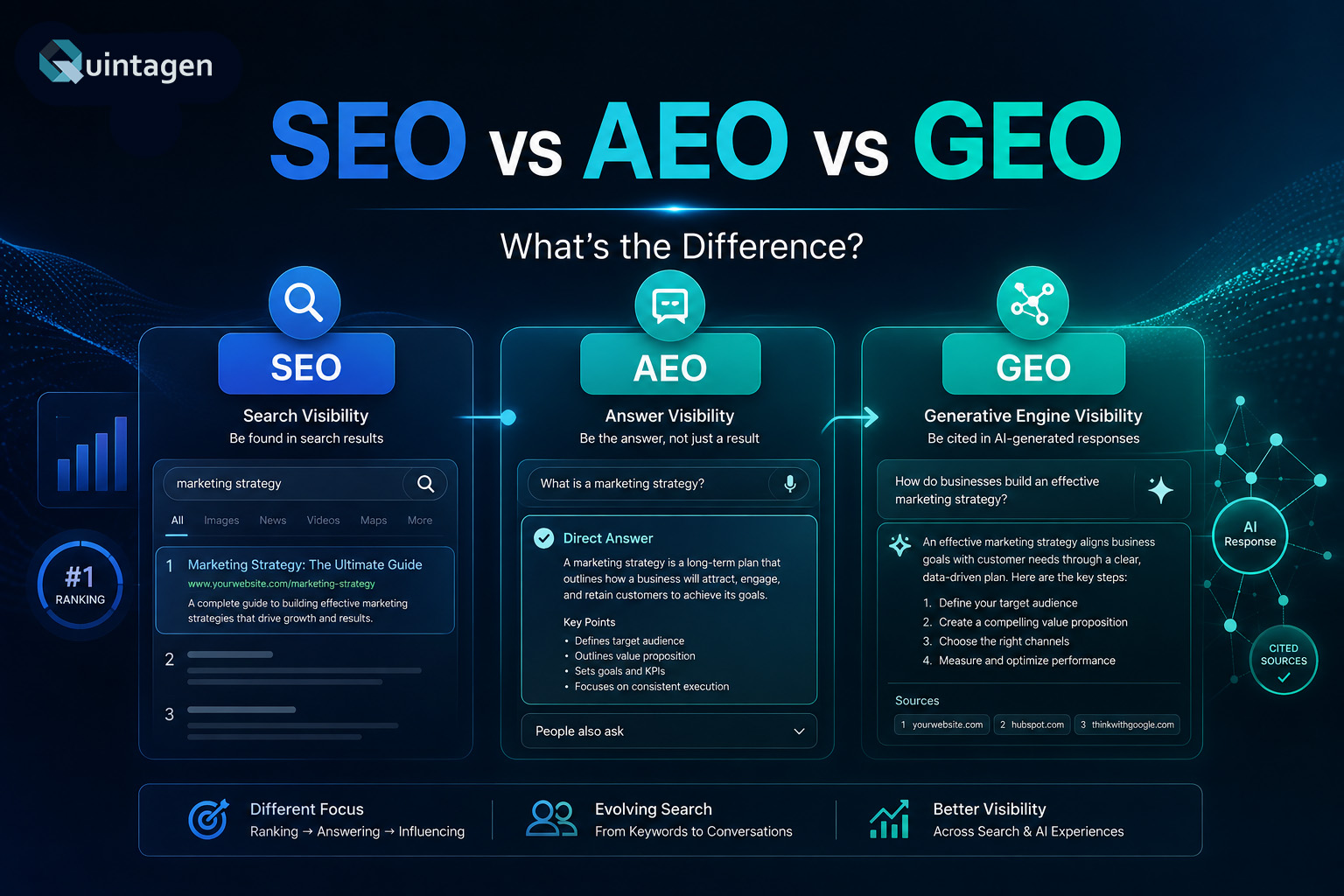
This is where SEO, AEO and GEO begin to overlap.
SEO helps content become discoverable.
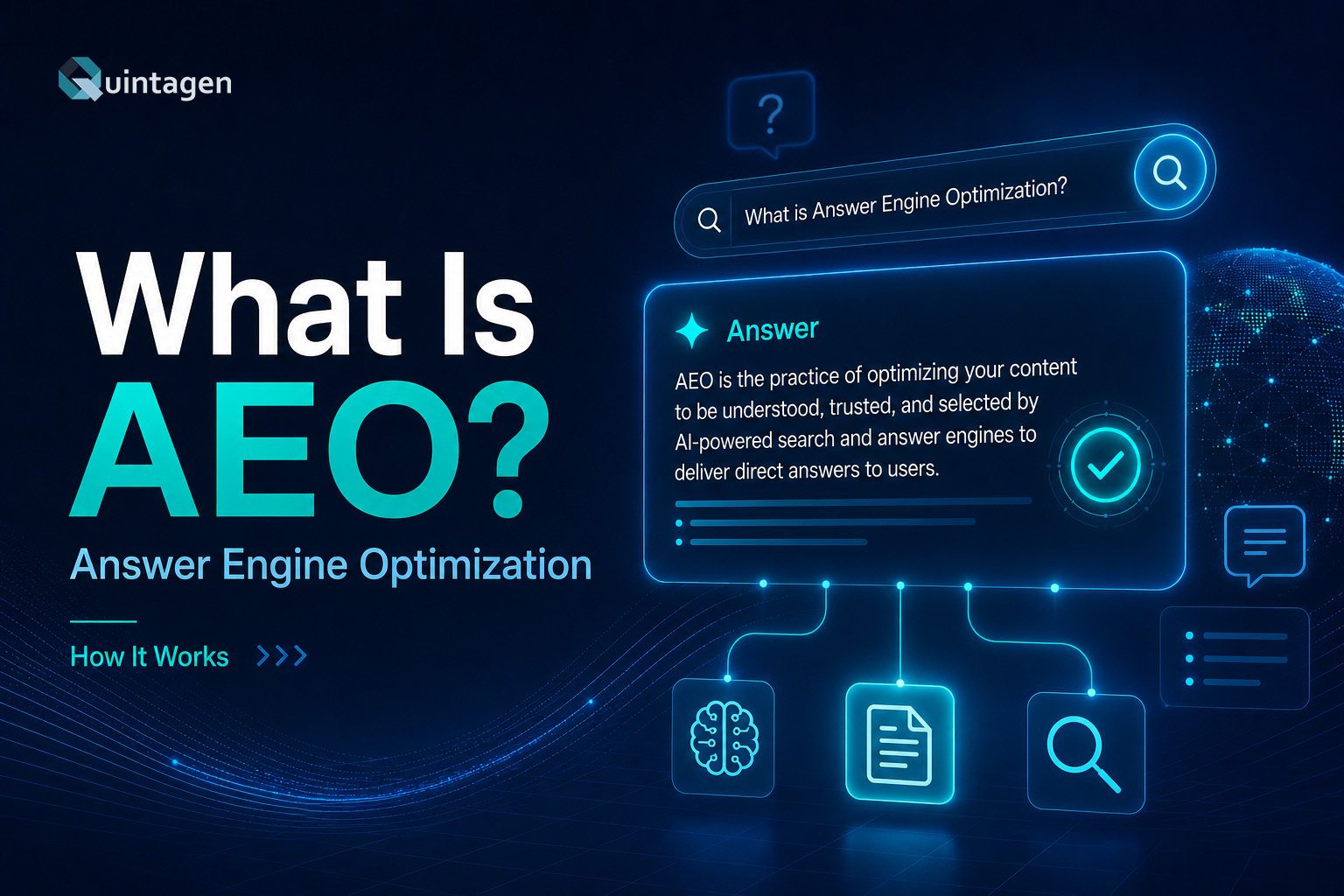
AEO improves how clearly content answers specific questions.
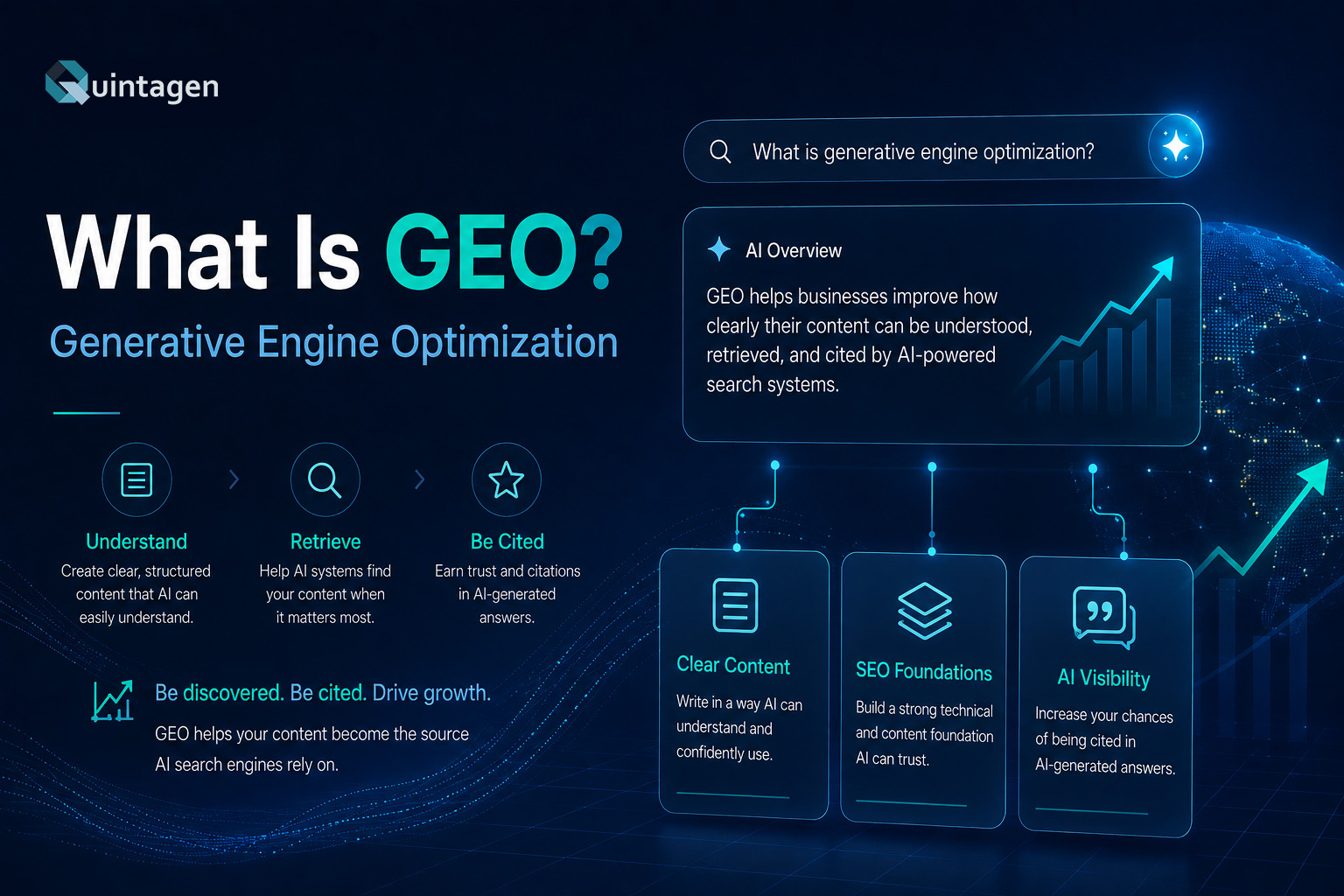
GEO looks more broadly at how a business and its information may be understood and used within generative search experiences.
For a clearer comparison, read: SEO vs AEO vs GEO: What’s the Difference?
You can also explore the individual concepts in:
What Should Businesses Do as Search Behaviour Changes?
Businesses do not need to rebuild their entire digital strategy every time a new AI search feature launches.
A more practical approach is to strengthen the fundamentals.
Start by understanding the questions customers actually ask. Then make sure your website provides clear and useful information around those questions.
Important services should be easy to understand, related topics should be connected through internal links, and the website should demonstrate genuine knowledge rather than publishing large amounts of generic content.
It is also worth reviewing whether your website clearly communicates the business itself. Search systems should not need to guess what the company does, who it helps or how its different services relate to one another.
The next step is not to create separate pages for every possible AI question. It is to build a useful body of connected information around the subjects that matter to your customers and your business.
We will cover the practical implementation in a separate guide:
How to Optimize Your Website for AI Search and Generative Engines
Is AI Search Replacing Traditional Search?
Not currently.
AI search is better understood as an evolution of search rather than the immediate replacement of traditional search.
Users will still perform simple searches where a traditional result, map, product listing or website is the most useful response.
At the same time, AI-powered experiences are expanding the types of questions people can realistically ask search engines.
This is particularly noticeable for searches involving:
- comparisons
- recommendations
- research
- planning
- complex questions
- multiple requirements
- follow-up questions
Google has said that its newer AI search features are leading users to ask new and more complex questions and to search more frequently.
Businesses should therefore prepare for a search environment where traditional results and AI-generated experiences exist alongside one another.
Frequently Asked Questions
What does AI search mean?
AI search refers to search experiences that use artificial intelligence to understand questions, retrieve relevant information and provide answers, summaries or recommendations rather than only displaying a traditional list of links.
What are examples of AI search?
Examples include Google’s AI Overviews and AI Mode, ChatGPT Search and other search experiences that combine web retrieval with AI-generated responses.
Is AI search the same as GEO?
No. AI search describes the search experience or technology. GEO, or Generative Engine Optimization, describes strategies intended to improve how clearly a business and its content can be understood and used within generative search environments.
Does AI search replace SEO?
No. Strong SEO foundations remain important because AI-powered search systems still need to discover, access and understand information from websites.
Final Thoughts
AI search is changing search from a process built mainly around keywords and lists of links into a more conversational way of finding, comparing and understanding information.
People can ask longer questions, provide more context and continue their research through follow-up conversations. At the same time, AI systems can summarize information from several sources before a user decides where to click.
For businesses, the practical response is not to chase every new AI search feature.
It is to make the business and its expertise easier to understand, create genuinely useful content, answer important customer questions clearly and maintain strong SEO foundations.
The platforms will continue to change. The need to provide useful, trustworthy and understandable information will remain.