Search is changing.
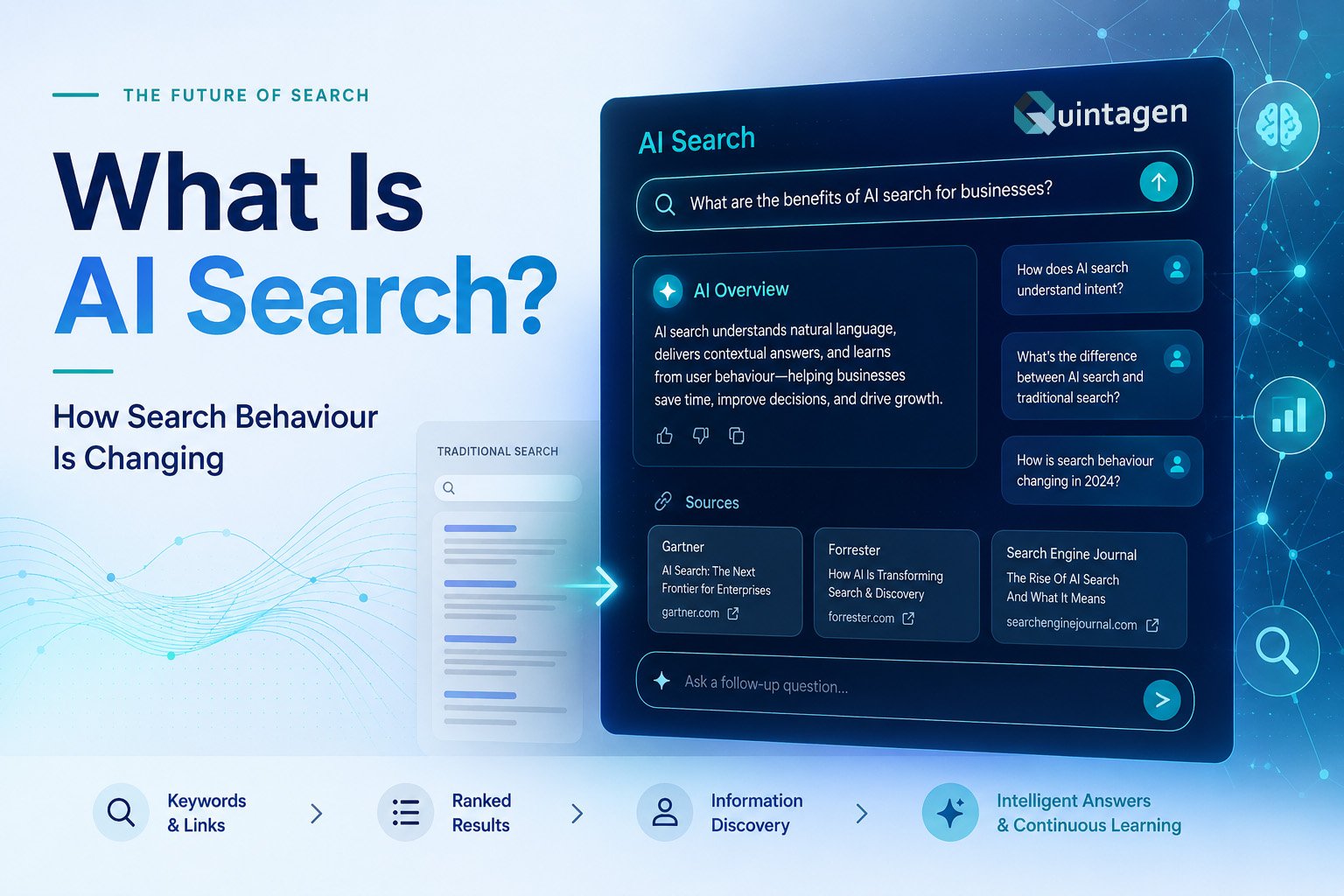
People still use Google to find websites, products and services. But increasingly, they are also asking questions through AI-powered search experiences such as ChatGPT, Google AI Overviews, Microsoft Copilot and Perplexity.
Instead of showing only a list of links, these platforms can generate an answer directly.
For businesses, this creates a new question:
How can your business become visible when AI systems generate the answer?
This is where Generative Engine Optimization, or GEO, comes in.
What Is Generative Engine Optimization (GEO)?
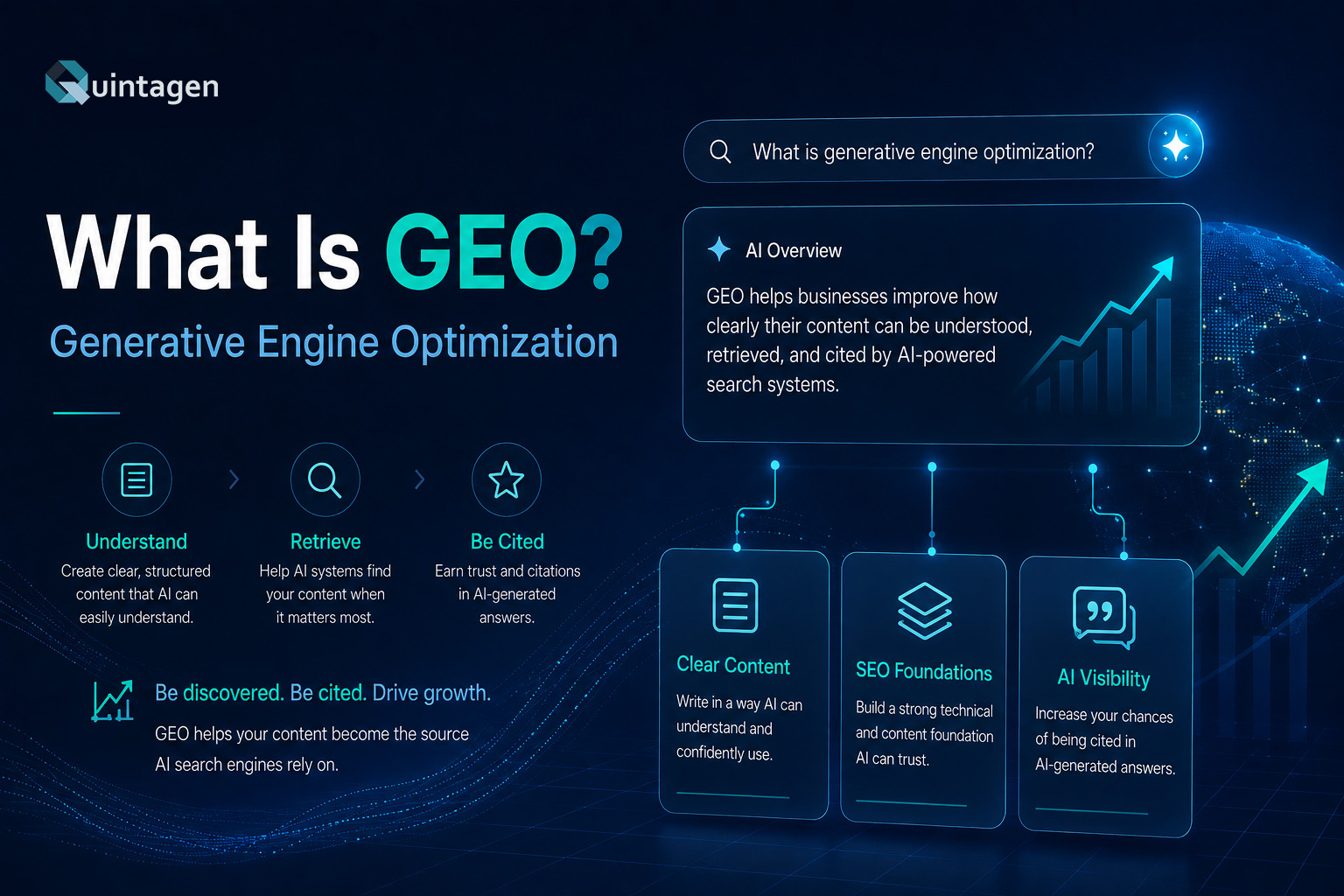
Generative Engine Optimization (GEO) is the practice of improving how clearly and reliably a business, website or piece of content can be understood, retrieved, referenced or cited by AI-powered search systems.
In practical terms, GEO helps AI systems understand:
- what your business does
- what services or expertise you provide
- who you serve
- what topics your website covers
- whether your information is credible
- when your content is relevant to a user’s question
GEO does not replace traditional Search Engine Optimization.
It builds on many of the same foundations, including useful content, technical accessibility, clear website structure and authority, while adapting them for a search environment where users increasingly receive generated answers.
Why Is GEO Important?
Traditional search queries are often relatively short.
For example:
SEO agency Malaysia
An AI search query can be much more conversational:
What should a Malaysian B2B company look for when choosing an SEO agency?
The second question requires more than matching a keyword.
An AI system may need to understand what the user is trying to achieve, identify useful information, compare different sources and generate an answer that addresses the question.
This means businesses increasingly need to think beyond rankings alone.
Your website should also provide information that is:
- easy to understand
- clearly structured
- relevant to specific questions
- supported by credible information
- connected to your wider area of expertise
The goal is not simply to rank for a keyword.
It is to make your business and content easier for both search engines and AI systems to understand.
How Does GEO Work?
The exact process differs between platforms, but a simplified AI search journey may look like this:
- A user asks a question.
- The system interprets the user’s intent.
- Relevant information is retrieved from available sources.
- Different pieces of information are evaluated and combined.
- The system generates an answer.
- In some cases, sources, citations or links are shown alongside the answer.
GEO focuses on improving the quality, clarity and usefulness of the information available during this process.
There is no guaranteed method for appearing in every AI-generated response.
However, a website with clear business information, strong SEO foundations, useful content and credible supporting signals is generally better positioned to be understood and retrieved than a website that provides vague or poorly structured information.
GEO vs SEO: What Is the Difference?
SEO and GEO are closely related, but they focus on different types of search visibility.
| SEO | GEO |
|---|---|
| Focuses primarily on traditional organic search visibility | Focuses on visibility within AI-generated search experiences |
| Aims to improve rankings, impressions, clicks and organic traffic | Aims to improve retrieval, references, mentions and citations |
| Optimizes pages around search intent and search engine requirements | Optimizes information so generative systems can understand and use it |
| Commonly measures rankings, clicks, impressions and conversions | May also track AI mentions, citations and referral traffic |
The two should not be treated as competing strategies.
A stronger approach is to combine:
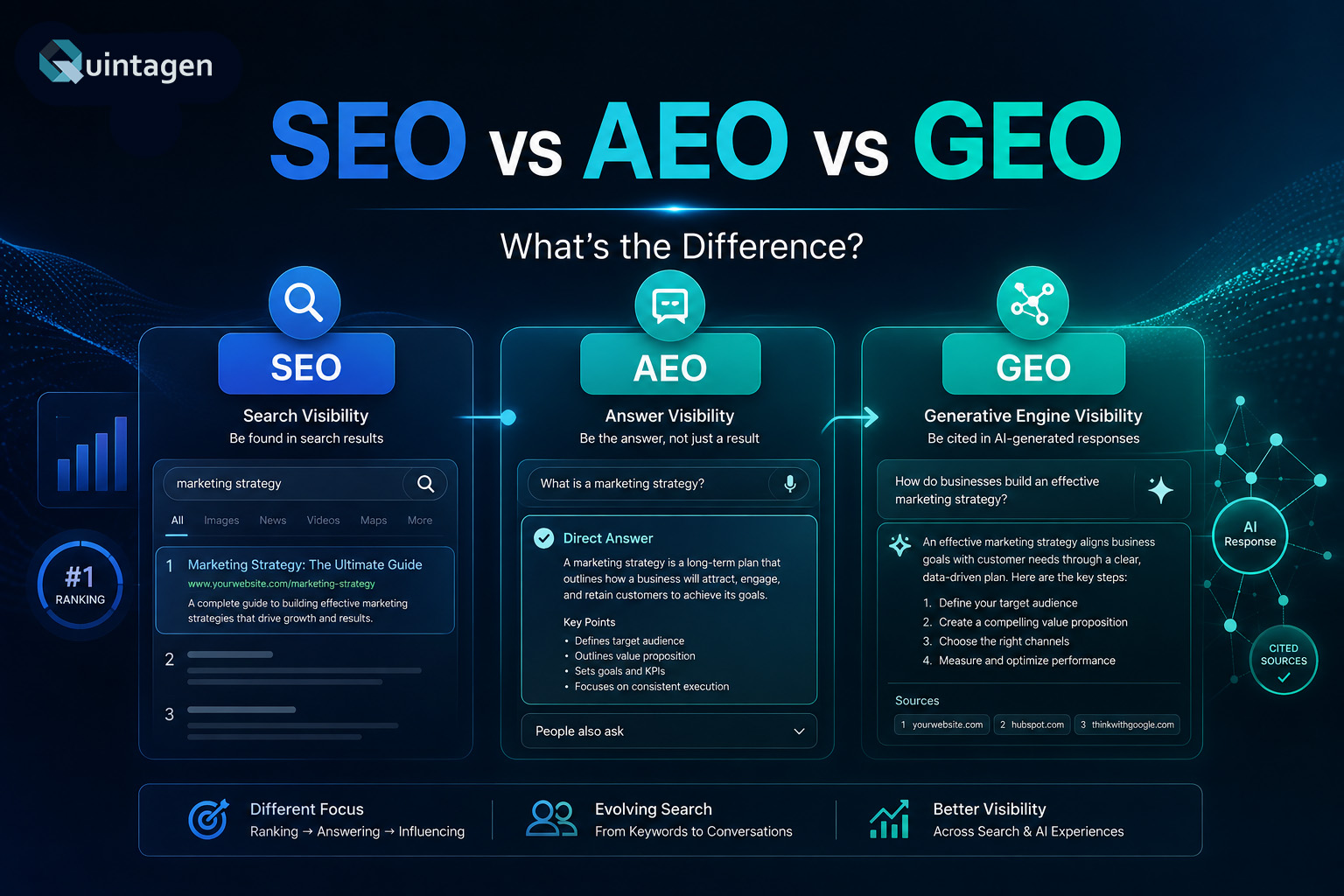
SEO + AEO + GEO
SEO helps your website become discoverable through search.
AEO helps your information become easier to extract and use as a direct answer.
GEO focuses on how your business and content may contribute to generative AI responses.
For a clearer comparison, read: SEO vs AEO vs GEO: What’s the Difference?
Does GEO Replace SEO?
No.
GEO still depends heavily on strong search and website fundamentals.
Your website should remain:
- crawlable
- indexable
- technically accessible
- well structured
- relevant
- useful
- trustworthy
- easy to navigate
If search systems struggle to discover or understand your website, it becomes more difficult for your information to participate effectively in AI-powered search experiences.
For most businesses, GEO should therefore be viewed as an extension of a broader search strategy rather than a replacement for SEO.
What Is the Difference Between SEO, AEO and GEO?
The terminology can become confusing because the three areas overlap.
A simple way to understand them is:
SEO: Search visibility
Search Engine Optimization focuses on helping your website become visible in traditional organic search results.
It includes areas such as keyword targeting, search intent, technical SEO, content quality, internal linking, authority and website performance.
AEO: Answer visibility
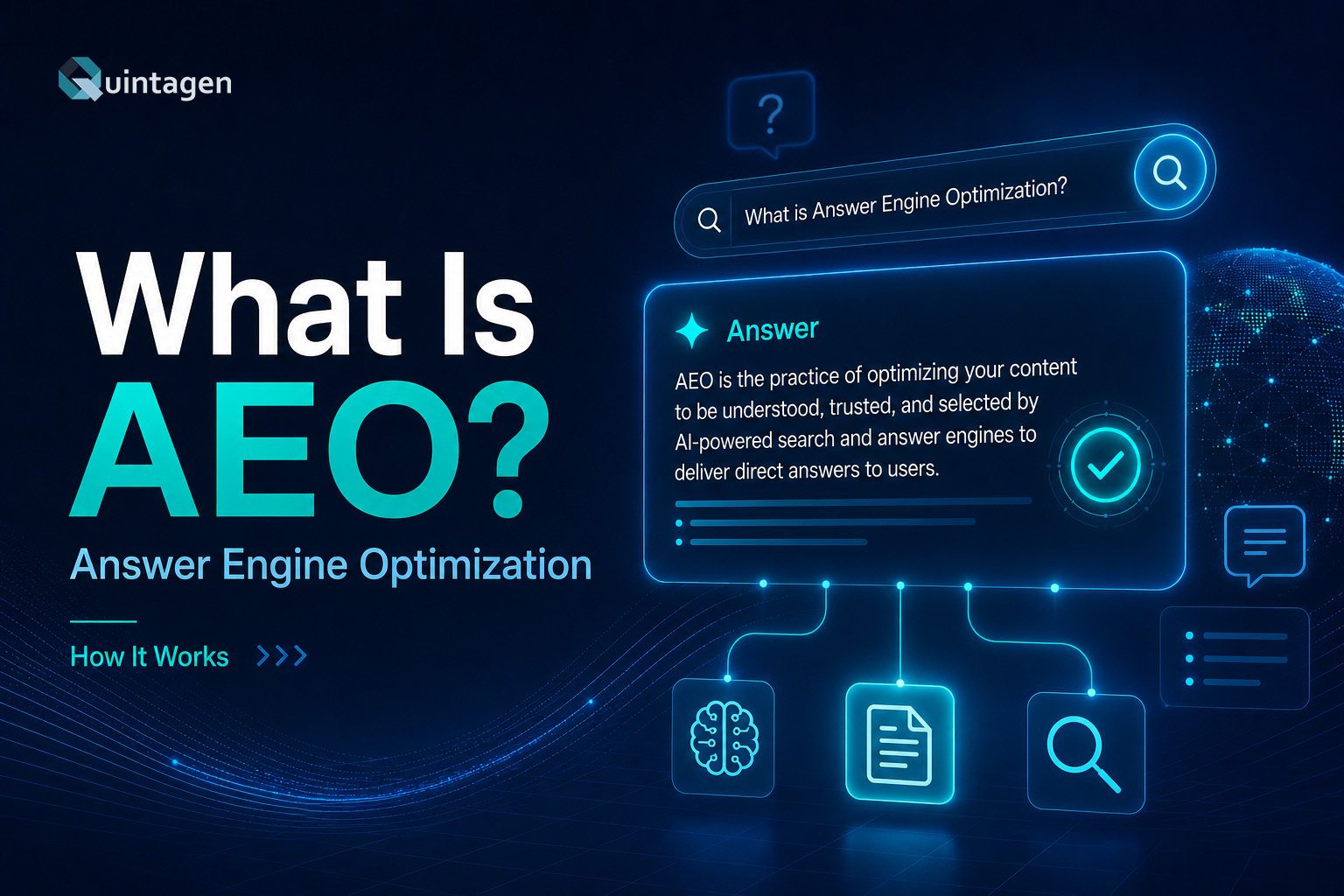
Answer Engine Optimization focuses on making information easier for search and AI systems to identify, extract and present as a direct answer.
Clear definitions, FAQs, question-based headings and concise explanations can all support this.
GEO: Generative visibility
Generative Engine Optimization focuses more broadly on helping your content, expertise and business information become understandable and useful within AI-generated responses.
These disciplines should work together.
The objective is not to optimize a website separately for every new acronym. It is to create a strong digital presence that people, search engines and AI systems can understand.
How Can Businesses Improve GEO?
There is no single GEO tactic that guarantees AI visibility.
Instead, businesses should strengthen the overall quality and clarity of their digital presence.
1. Answer important questions directly
Do not hide the main answer several paragraphs into a page.
When a customer asks a clear question, provide a clear answer.
For example, a page targeting “What is GEO?” should define GEO near the beginning before moving into more detailed explanations.
This makes the content easier for readers to understand and easier for search systems to interpret.
2. Create useful, comprehensive content
A strong article should answer the main question as well as the logical questions that follow.
For a GEO article, readers may also want to know:
- how GEO works
- how GEO differs from SEO
- how GEO differs from AEO
- whether GEO replaces SEO
- how businesses can improve AI visibility
- how GEO can be measured
Cover these questions where they naturally belong.
Comprehensive does not mean unnecessarily long. Every section should help the reader understand the subject or make a better decision.
3. Explain your business clearly
One of the simplest improvements businesses can make is also one of the most important.
Your website should make it obvious:
- who your company is
- what services you provide
- who you help
- where you operate
- what problems you solve
Avoid relying on vague statements such as “we provide innovative digital solutions.”
Specific information gives customers and search systems more useful context about your business.
4. Build topical depth
One article alone does not demonstrate complete expertise around a subject.
Businesses can build stronger topical coverage by creating connected content around their main areas of expertise.
For example, a GEO and AI search content cluster could include:
- What Is GEO?
- What Is AEO?
- SEO vs AEO vs GEO
- What Is AI Search?
- How to Optimize Your Website for AI Search
- How Do AI Search Engines Choose Sources to Cite?
- How to Measure AI Search Visibility
These articles should link to one another where relevant.
Over time, this creates a clearer relationship between the topics your business discusses and the services you provide.
5. Use a clear website structure
Good website structure benefits both people and search systems.
Useful practices include:
- descriptive page titles
- logical heading structures
- focused sections
- descriptive internal links
- readable layouts
- clear navigation
- relevant service and supporting pages
A search system should not have to guess what a page is about or how it relates to the rest of your website.
6. Support important claims
Credibility matters.
Where appropriate, support important claims using:
- reliable external sources
- documentation
- original research
- practical examples
- case studies
- first-hand experience
- proprietary data
Avoid making claims that cannot be demonstrated or verified.
This is particularly important for topics involving rapidly changing technology.
7. Add original value
Publishing more content does not automatically create more authority.
Generic articles that repeat the same information available across hundreds of websites provide limited differentiation.
Businesses can create stronger content by adding:
- practical advice
- original examples
- industry experience
- local market knowledge
- lessons from real projects
- expert observations
- original research or data where available
The goal should be to contribute something genuinely useful to the topic.
8. Maintain strong technical SEO
GEO should not distract businesses from technical fundamentals.
Important areas still include:
- crawlability
- indexability
- mobile usability
- website performance
- HTTPS
- internal linking
- canonical tags
- appropriate structured data
- clean website architecture
Technical problems can limit the visibility of even excellent content.
9. Keep business information consistent
Search systems encounter information about businesses across many different sources.
Your company name, services, location and other important information should therefore remain accurate and consistent across your website and relevant third-party platforms.
Consistency makes it easier to understand that different references relate to the same business.
What Does GEO Mean for a Business Website?
A modern business website should do more than describe the company.
It should answer the questions customers ask while researching a problem, comparing solutions or deciding who to work with.
For example, an SEO provider might create useful content around questions such as:
- What is SEO?
- How long does SEO take?
- How is SEO performance measured?
- SEO vs paid advertising: which is better?
- How does AI search affect SEO?
- What should a business look for when choosing an SEO provider?
This type of content helps potential customers make better decisions.
At the same time, it gives search and AI systems additional context about the company’s areas of expertise.
Can GEO Help Your Business Appear in ChatGPT?
Potentially, but no company can guarantee that a particular business will appear in a specific ChatGPT answer.
The same applies to other generative search platforms.
Different platforms may use different sources, retrieval systems and methods for generating responses. Results can also vary depending on the wording of a question and the context surrounding it.
A practical GEO strategy therefore focuses on strengthening the conditions that can support AI visibility, including:
- clear business information
- useful content
- subject expertise
- technical accessibility
- consistent entity information
- wider web visibility
- credible third-party references
Businesses should be cautious of anyone promising a permanent number-one ranking in ChatGPT or guaranteed placement in every AI-generated response.
How Is GEO Measured?
GEO measurement is still developing.
Unlike traditional SEO, there is no single universal reporting system that shows every time a business has been referenced by an AI platform.
Businesses can instead monitor a combination of indicators, including:
- AI-generated citations
- brand mentions in AI answers
- pages referenced by generative search systems
- referral traffic from AI platforms
- visibility for important customer questions
- organic search impressions
- organic clicks
- leads and conversions generated through search
Traditional SEO performance remains important.
Ultimately, GEO should support the wider objective of improving digital visibility and generating meaningful business outcomes, rather than simply increasing the number of AI mentions.
Is GEO Only Relevant to Large Companies?
No.
Smaller and more specialised businesses may have opportunities to become useful sources within specific industries, locations and areas of expertise.
For example, a Malaysian service provider does not necessarily need to compete for every global digital marketing query.
It may be more valuable to create strong content around the specific questions Malaysian businesses ask when evaluating SEO, AI search, digital marketing or website solutions.
Specific expertise can be an advantage.
Common GEO Mistakes
As interest in AI search grows, businesses should avoid several common mistakes.
Treating GEO as a shortcut
There is no single setting, schema type or piece of code that automatically makes a website authoritative in AI-generated search.
GEO requires strong foundations across content, technical SEO, business clarity and wider digital credibility.
Ignoring traditional SEO
AI search does not make crawlability, indexing, website structure or search relevance unimportant.
SEO remains a critical foundation.
Publishing large amounts of generic AI content
Publishing hundreds of repetitive articles does not automatically create authority.
A smaller library of genuinely useful content can be more valuable than a large amount of low-value material.
Writing only for machines
The primary purpose of business content should still be helping people.
Content should remain clear, natural and genuinely useful to the reader.
Creating separate pages for every keyword variation
Businesses do not need one article for “what is GEO,” another for “GEO meaning” and another for “Generative Engine Optimization meaning” when those searches share the same intent.
One strong, comprehensive page can often address them together.
Making AI ranking guarantees
Generative answers are dynamic.
No legitimate strategy can guarantee permanent placement across every AI platform, question or user.
A Practical GEO Framework for Businesses
Businesses beginning to prepare for AI-driven search can start with the following process:
- Clearly explain who your business is and what you provide.
- Make sure your website can be crawled and indexed.
- Identify the questions customers ask throughout their buying journey.
- Create genuinely useful content around those questions.
- Structure information with clear headings and direct answers.
- Support important claims with credible evidence.
- Build related content around your core areas of expertise.
- Link relevant articles and service pages together.
- Keep important business information consistent across the web.
- Monitor both traditional organic search and emerging AI visibility.
- Continue improving content as search behaviour changes.
GEO should be treated as an ongoing part of digital visibility, not a one-time optimization exercise.
How Quintagen Approaches GEO
At Quintagen, we view GEO as part of a broader search visibility and digital growth strategy.
The focus is not on chasing individual AI platforms or promising guaranteed AI rankings.
Instead, the objective is to build stronger digital foundations that make a business easier to discover, understand and trust.
Depending on the needs of the business, this may involve areas such as:
- Search Engine Optimization
- Answer Engine Optimization
- Generative Engine Optimization
- content strategy
- technical SEO
- website structure
- website development
- digital marketing
These areas work together.
A technically strong website provides the foundation. Clear content helps search systems understand the business. SEO improves discoverability. AEO improves answer readiness. GEO extends that visibility into generative search experiences.
The wider goal is to turn better visibility into stronger traffic, customer journeys, enquiries and digital performance.
Frequently Asked Questions About GEO
What does GEO stand for?
GEO stands for Generative Engine Optimization. It refers to improving how clearly and reliably business information and content can be understood, retrieved, referenced or cited by AI-powered search systems.
What is GEO in digital marketing?
In digital marketing, GEO focuses on improving a brand or website’s visibility within generative AI search experiences. It complements SEO and AEO by making content clearer, more useful and easier for AI systems to understand.
Is GEO the same as SEO?
No.
SEO focuses primarily on visibility in traditional organic search results. GEO focuses on visibility within AI-generated search experiences.
However, strong SEO remains an important foundation for GEO.
Is GEO the same as AEO?
Not exactly.
AEO focuses mainly on making information suitable for direct answers, while GEO focuses more broadly on how information, expertise and brands may appear within generative AI responses.
The two approaches overlap and are often most effective when used together with SEO.
Does GEO replace SEO?
No.
GEO should complement SEO rather than replace it. Crawlability, indexing, relevance, website structure, authority and technical performance continue to matter.
Can GEO guarantee visibility in ChatGPT?
No.
GEO can strengthen the factors that support AI search visibility, but no agency or optimization method can guarantee that a business will appear in a specific ChatGPT response.
How can a business start with GEO?
Start by making your business easy to understand, ensuring your website is technically accessible, answering important customer questions, building useful topic coverage and keeping your business information consistent across the web.
Final Thoughts
Generative AI is changing the way people discover and evaluate information online.
Businesses therefore need to think beyond simply appearing in a list of search results.
They increasingly need to be:
discoverable, understandable, credible and useful.
SEO remains the foundation for organic visibility.
AEO helps your information become easier to use as a direct answer.
GEO extends that thinking into generative AI search experiences.
Businesses that build clear websites, useful content, strong technical foundations and credible digital signals will be better prepared as search continues to evolve.